The Foundation for
What’s Next

A Proposal for Dollar General Technology Leadership

Changing how work gets done

For Dollar General, this isn’t about bolting AI onto the business you already run, it’s about changing how the business operates.

That shows up in three places. And this is the lens for the entire conversation.

01
Build capability everywhere

You’re trying to put AI-building capability into the hands of every employee, not just a centralized team.

This isn’t about giving people access to a model and calling it done.

That’s table stakes, and every company is already doing it.

The goal is a workforce that can build with AI as a normal part of doing the job, not just use what’s handed to them.

02
Give agents the ability to act

You’re enabling AI agents to act inside the business, executing workflows, touching applications, APIs, and data. Not just answering questions about them. That’s a meaningfully different bar than chatbots or copilots. It’s automation with the ability to take action.

03
Fund it without bloating the cost structure

None of this changes the financial reality: every dollar spent still has to prove operational efficiency.

Dollar General has put a 6% to 7% operating margin target in front of investors while also signaling a willingness to absorb near-term cost to fund the AI build-out.

Every other line item, including legacy infrastructure, is under real pressure to either earn its place or get cut.

01

Build Capability Everywhere

What’s Required

The governance layer that makes “everyone builds” a capability the business can trust.

Allowing everyone to build requires a way to control and govern how they build.

That means governing what gets built, what tools AI can access, what data it can touch, and how every action gets logged.

Without that layer, “everyone builds” doesn’t scale.

It fragments into hundreds of ungoverned experiments instead of one capability the business can trust.

Why Cloudflare

One governed foundation for everyone to build on.

Cloudflare didn’t just build AI solutions to sell to customers.

It built the governance foundation that enables every employee to build with AI, then made that same foundation available to customers like Dollar General.

MCP Server Portals provide a single, centralized point where every AI tool and agent connection is authenticated, scoped to least-privilege access, and logged automatically.

Unapproved AI tools are identified before they become the thing nobody knew was running.

What This Looks Like at Dollar General

A merchandising analyst, a finance team member, and an HR business partner are each building internal AI workflows on top of Data Engineering’s foundation, using only pre-approved tools exposed through MCP Server Portals, with authentication, authorization, and logging already in place.

No IT ticket.
No waiting for a centralized team.
No ungoverned experiments running where they can't be seen.

That’s what “every employee builds” looks like when the right governance layer exists underneath.

The recent decision to bring Data Engineering under the same leadership as AI strategy creates the organizational foundation for this approach. Governance now needs to evolve at the same pace as capability.

The same network that delivers every capability described in this proposal.

One foundation.

02

Give Agents the Ability to Act

You’re enabling AI agents to act inside the business, executing workflows, touching applications, APIs, and data. Not just answering questions about them.

What’s Required

This is where AI goes from answering questions to taking action, and where the controls that make that safe have to live.

You will be enabling AI agents to act. You’ll need visibility and control over what they do once they’re acting.

The moment AI moves from answering questions to taking action, touching applications, calling APIs, and reaching into data, the risk profile changes completely.

There’s no inspection of what an agent is sending or receiving.

No way to catch an unapproved AI tool connecting to something it shouldn’t.

No firewall built for AI-to-application or AI-to-API traffic anywhere in the stack today.

You’re extending trust to agents you can’t fully see.

Why Cloudflare

A control layer built for agents that act, not just AI that answers.

AI Security for Applications sits in front of your AI-powered applications and APIs, inspecting AI interactions for prompt injection, data leakage, and abuse.

It’s the layer that doesn’t exist in your stack today, purpose-built for the moment AI stops answering questions and starts taking action.

AI Gateway sits underneath as the control plane for every model your agents call, governing what gets used and how.

As Agentic Commerce expands and customers begin relying on AI agents to shop and make purchasing decisions on their behalf, this is the same layer that keeps those interactions trustworthy.
What it means to DG customers
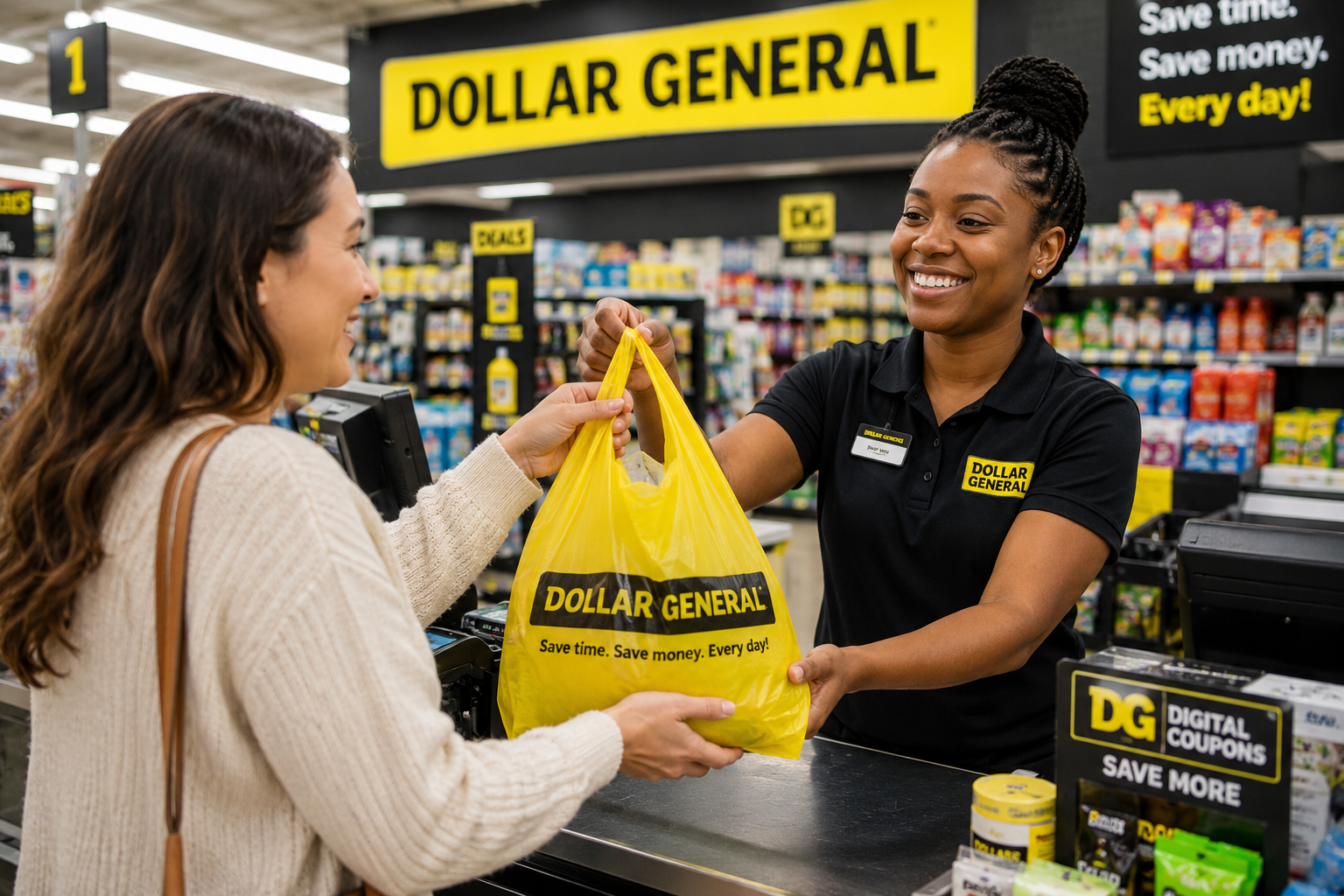
None of this is abstract to the customer walking into one of your stores. They don’t see the architecture. They see whether the shelf is stocked. They see whether the price is right. They see whether the business behind the counter can be trusted with their transaction.

For a large share of your rural customer base, you’re not one option among several. You’re often the only one nearby.

Modernizing the foundation is what lets Dollar General keep making good on that promise at the pace and scale your customer base requires.
03

Fund It Without Bloating the Cost Structure

You’re funding the future, while still paying a premium for the past.

What’s Required

This is how you fund the future without letting the cost structure become the next thing that needs fixing.

You’re still paying a premium for architecture designed for yesterday’s operating model while investing to build tomorrow’s.

Every dollar spent maintaining that legacy architecture is a dollar that isn’t supporting the AI operating model you’ve committed to building.

That starts with simplifying the technology underneath it. Security across your environment should share a single policy engine, regardless of whether an application runs in Azure, GCP, another cloud, or your own data center.

Individual security solutions managed independently create unnecessary operational complexity. Separate architectures. Separate policies. Separate management interfaces. As the AI operating model expands, continuing to support them requires more people and more tooling than necessary.

The remaining challenge is making sure the architecture supporting the AI operating model doesn’t work against the efficiency goals it’s meant to achieve.

Why Cloudflare

Consolidation. Higher productivity. Less operational burden. Faster execution.

Cloudflare consolidates security, application delivery, and network services onto a single global network. Instead of managing separate products, policies, and management interfaces, DG operates from one platform.

The result is less operational effort, fewer systems to maintain, fewer platforms to troubleshoot, and less time spent integrating, tuning, and managing infrastructure. Teams spend less time supporting technology and more time supporting the business.

Whether an application runs in Azure, GCP, or your own data center, the same network enforces the same policy everywhere. Policy changes are deployed globally in seconds instead of being recreated across multiple products by multiple teams.

The same network creates economies of scale. As DG expands its AI operating model, modernizes applications, or distributes infrastructure across regional colocation facilities, new capabilities don't require new architectures. AI governance, application security, DDoS protection, and future services are all delivered by the same network, allowing the platform to support more of the business without proportionally increasing operational complexity.

Cloudflare doesn't fund your entire AI strategy. It reduces unnecessary costs working against it.

The Comparison
Question Fragmented Today Cloudflare Foundation
How many tools to manage?Several, by environmentOne policy engine across all
How many teams to keep it current?Multiple, each tuning separatelyOne team, common rules everywhere
How does it scale with AI?More complexity, more overheadSame network, more workloads
What does each extra dollar buy?Maintaining yesterday’s architectureFreeing budget for the AI operating model
AKAMAI: BUILT FOR A DIFFERENT ERA

Akamai’s architecture was built for a different era of the Internet, before interactions between people, applications, APIs, and AI became central to how businesses operate.

Adding new capabilities on top of that foundation doesn’t change what sits underneath it. Maintaining that architecture today means continuing to invest in a foundation designed for yesterday’s operating model.

The cost isn’t simply the contract. It’s continuing to invest in an architecture that no longer aligns with where DG is headed.

Opportunity Ahead

Before Q4 2026, you’ll be making a renewal decision about your Akamai services.

This isn’t just a procurement moment. It’s an opportunity to ask whether the architecture that has served DG well is the right foundation to support what’s next.

CONTROLLING AI COSTS

Consolidating the fragmented security footprint is only half of the cost story.

The AI build-out itself needs the same discipline. If 4,500 corporate employees are calling different models through different tools with no spend visibility, AI costs don’t behave like a controllable operating expense.

They behave like cloud sprawl.

AI Gateway changes that. Spend limits can be set in actual dollars, not tokens, and governed by team, application, or model so AI costs remain predictable as adoption scales.

Dollar General can establish AI budgets for finance, merchandising, supply chain, HR, and other teams in actual dollars. AI spend becomes visible, governed, and reportable rather than another growing line item. That’s what lowering SG&A per unit of work requires: not simply more AI capability, but AI spending leadership can measure and finance can trust.

Cloudflare’s Architecture Matters to What’s Next at DG

For decades, security companies have largely answered the same question the same way: take infrastructure that already exists and layer security products on top of it. A box here. A proxy there. Routing traffic through a detour for inspection before continuing on its way.

Cloudflare asked a different question: Can the Internet itself become the security layer?

For DG, this architectural difference matters because you’re not looking for another security product.

You’re building an operating model defined by interactions between people, AI agents, applications, and APIs.

That requires a foundation designed to live in the direct path of those interactions, where they can be connected, protected, and governed.

Cloudflare doesn’t ask traffic to take a detour for inspection.

It already sits between users, applications, APIs, and AI, protecting and governing those interactions.

Security, networking, application delivery, and developer services all operate on that same network rather than being assembled from separate platforms.

That isn’t simply a different way of delivering security. It’s a different way of building Internet infrastructure.

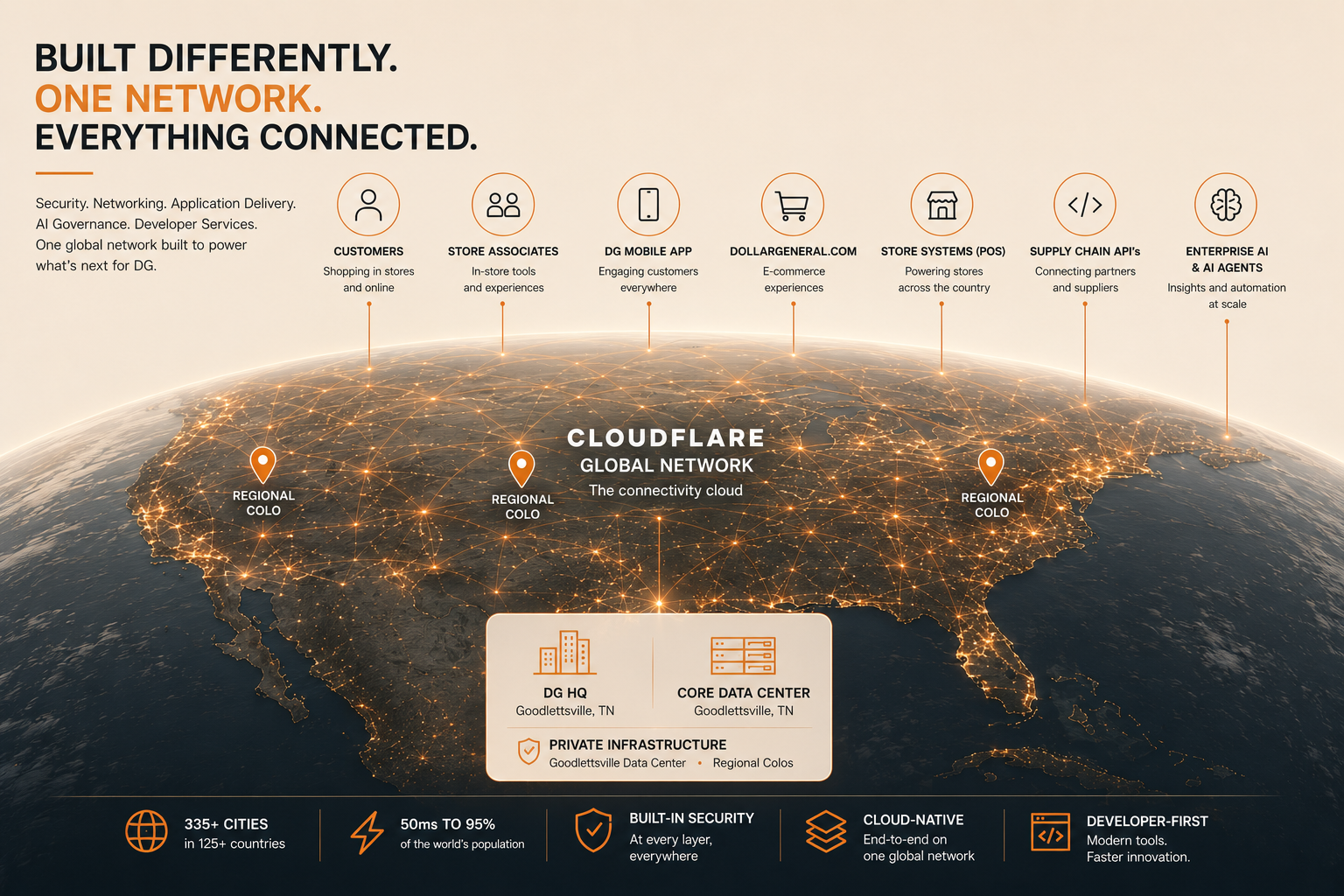
For DG, that means you don’t need to assemble separate foundations for networking, security, AI governance, and application delivery.

The same global network that protects roughly a quarter of the world’s Internet already provides the foundation underneath all of them.

That’s why AI Security for Apps, AI Gateway, MCP Server Portals, Core Layer 7 Security, DDoS Protection, and every other capability described throughout this proposal aren’t independent point solutions.

They’re all delivered by the same network.

Cloudflare doesn't live on a detour.

It doesn't live at a separate inspection point.

Cloudflare lives in the path.

Protecting the Return You’ve Already Committed To

What’s different in 2026 is that leadership publicly identified AI as one of the reasons operating costs will grow faster than sales.

Naming it changes the bar.

Every dollar invested in the AI operating model is now expected to produce the business outcomes it was intended to deliver.

Leadership has accepted higher near-term operating costs specifically to fund the AI build-out, a deliberate trade-off named publicly, separate from the routine capital going toward new stores and remodels.

That’s not a budget line. That’s a bet.

And every bet is now expected to produce a return.

The risk goes well beyond breaches and downtime.

The risk is also about whether these investments can deliver the business outcomes they were intended to produce.

What’s at Stake

The financial risk extends well beyond the cost of recovering from a breach or outage.

The table below illustrates the business value now dependent on the successful execution of DG’s AI operating model.

Business OutcomeEstimated Annual Value
Productivity gains from AI~$28M/year
If operating margin improves by just 0.10% (10 bps)~$43M/year
If operating margin improves by 0.25% (25 bps)~$107M/year
If operating margin improves by 0.50% (50 bps)~$215M/year
Cost of delay — every quarter the AI rollout slips~$7M/quarter

*Assumptions: ~4,500 AI users, 20 minutes/day, 250 workdays/year, $75/hour loaded labor cost. **1 basis point = 0.01%.

These figures illustrate the financial value dependent on successful AI execution. Delays postpone the return on investments DG has already made. If AI is adopted by approximately 4,500 corporate employees and saves 20 minutes per employee per day, Dollar General stands to recover roughly 375,000 productive hours annually.

Where the Numbers Come From

On the Q1 2026 earnings call, leadership described the purpose of the AI operating model in explicit terms: lowering SG&A per unit of work over time.

That’s a productivity goal, not just a cost-cutting one.

It’s about getting more output, completing more work, and increasing efficiency without growing administrative overhead at the same rate.

The $28M productivity figure isn’t hypothetical.

It’s the publicly stated SG&A-per-unit-of-work objective expressed in dollars.

Every quarter the AI rollout is delayed, postpones the productivity gains and operating efficiencies leadership has already committed to delivering.

Cloudflare’s Value

Cloudflare enables DG to build, operate, and scale its AI operating model with confidence.

By governing AI interactions, securing applications, simplifying the underlying architecture, and controlling costs as adoption scales, Cloudflare protects the return those investments are intended to produce.

Cloudflare’s Origin Story

Built as a System, Ready for What Nobody Saw Coming

The Cloudflare story starts in 2004 with a question: where does email spam actually come from? To answer it, the founders built Project Honey Pot, a distributed system that let any website owner plant tracking traps for spammers and malicious bots, mapping their behavior across the internet in real time. Over five years, thousands of websites in 185 countries joined.

The dataset grew massive. And users kept pushing for more capability - “don't just track the bad guys. Stop them.”

~25%
of the world's internet traffic flows through Cloudflare
337+
cities across 125+ countries
350+
AI models
80%
of the top 50 generative AI companies run on Cloudflare
210+
AI inference locations
What the Founders Actually Built

Lee Holloway didn’t build another web proxy. He built a globally distributed reverse proxy layer that ran the same software stack on every machine, everywhere, simultaneously.

The physical infrastructure was unremarkable: commodity x86 servers in colocation facilities around the world, nothing exotic.

The radical part was the software architecture and what it was designed to do.

Rather than sending traffic to a specialized system for caching, then another for security, then another for routing, Lee built a unified packet-to-application processing pipeline where a request arrives, gets parsed, hits security logic, gets routed, and gets served, all inside the same system.

Combined with anycast routing (where every Cloudflare location shares the same IP address and the internet automatically routes users to the nearest one), this meant that any Cloudflare server anywhere in the world could handle any request for any customer.

Why didn't everyone build it this way?

Because it is brutally hard.

It required writing high-performance networking code to make security fast enough not to slow everything down.

It required solving distributed systems problems at a scale most companies avoid: pushing policy changes globally in seconds, keeping every location consistent, failing over gracefully if parts of the network go down.

And it required walking away from the business model most networking companies were built on: selling high-margin hardware appliances.

Cloudflare's entire bet was that if you own the network, you don't need to sell boxes.

How Cloudflare Grew Without Bolting Things On

Cloudflare didn't build services on top of a proxy, it built a network. That difference is now visible in every enterprise conversation about what infrastructure can actually support the next ten years.

Where Cloudflare Stands Today, and Why AI Changes Everything

By 2025, Cloudflare was processing traffic for roughly 20% of all websites on the internet. But revenue and growth are not the real story.

The real story is architectural timing.

AI agents are not like traditional software.

Traditional software runs in predictable locations, on predictable schedules, talking to known endpoints.

AI agents are autonomous.

They make decisions, call APIs, spin up processes, and talk to other agents. Constantly, globally, simultaneously, and at a scale that was unthinkable five years ago.

They need infrastructure that is globally distributed, low-latency, secure by default, and instantly available, with no servers to provision and no regions to choose.

Cloudflare has been building exactly that infrastructure for fifteen years, without knowing AI agents would need it.

That foundation was not built for AI. But it turns out, building for the hardest problems on the internet (global scale, millisecond latency, consistent security everywhere, no boxes) is exactly what AI needs.

Today, that foundation is the exact infrastructure that AI agents need to work at scale: fast, global, secure by default, no boxes, no backhauling.

Cloudflare did not predict AI.

They just built the right thing, and AI arrived.

2010
CDN, DDoS, WAF
2014
Threat protection, SSL for all
2017
Cloudflare Workers. The moment the network became a compute platform.
2018
1.1.1.1 public DNS resolver. Cloudflare now processing a meaningful percentage of the world's DNS queries.
2019
IPO on NYSE. Cloudflare One and Zero Trust products begin (WARP, Gateway, Access), built natively onto the existing network.
2020–2022
WAN, CASB, DLP, Email Security
2023–2024
Workers AI. NVIDIA GPUs deployed across 210+ cities. AI Gateway for model routing, observability, caching, and unified billing across 350+ models.

Cloudflare by the Numbers

Network
Cities337+
Countries125+
Network capacity500 Tbps
Peering connections13,000+
Latency P95 global~50ms
AI inference locations210+
Traffic
HTTP requests/sec (avg)93M
HTTP requests/sec (peak)126M
DNS queries/sec~85M
Web traffic share~20%
Top 50 genAI companies80%
Security
Threats blocked/day
(2025 avg)
230 billion
Largest DDoS
(bandwidth)
31.4 TbpsNov 2025
Largest DDoS
(packet rate)
14.1B ppsOct 2025
Largest HTTPS DDoS205 MrpsDec 2025

More Resources & Listening

Selected podcasts, analysis, and primary sources on Cloudflare, AI infrastructure, quantum readiness, and the current threat landscape.

AI Agents

Agents Week 2026

Join us for Agents Week 2026, where we celebrate the power of AI agents and explore how they're transforming the way we build, secure, and scale the Internet.

cloudflare.com/agents-week
Podcasts

Decoder with Nilay Patel — Why Cloudflare’s CEO Is the Internet’s Unlikely Defender

Useful overview of what Cloudflare is and why its role in internet infrastructure is unusual.

podcasts.apple.com → Decoder
AI and Architecture

Cloudflare and the New Internet Architecture

Independent essay on network-layer convergence.

nikhs.substack.com
AI and Architecture

Cloudflare Investor Day — June 9th, 2026

Official earnings calls, investor days, and presentations.

cloudflare.net/events-and-presentations
Quantum Readiness

Cloudflare Becomes the First and Only SASE to Support Modern Post-Quantum Encryption

February 2026 milestone.

finance.yahoo.com
Threat Landscape and Scale

Cloudflare — 2026 Threat Report

How attacks are changing across the network.

blog.cloudflare.com/2026-threat-report
Threat Landscape and Scale

Cloudflare — Famous DDoS Attacks: The Largest Attacks of All Time

The largest attacks mitigated on the network.

cloudflare.com/learning/ddos/famous-ddos-attacks
AI Cost Management

Your AI Bill Is Out of Control. Cloudflare Can Fix It Now.

Introducing dollar-denominated spend limits in AI Gateway — budgets in dollars, not tokens, scoped by team, model, or application.

blog.cloudflare.com/ai-gateway-spend-limits
AI Agents

Agents Week 2026

Join us for Agents Week 2026, where we celebrate the power of AI agents and explore how they're transforming the way we build, secure, and scale the Internet.

cloudflare.com/agents-week
🏗 Cloudflare Security Architecture - Soup-to-Nuts